

The Privilege of Ordinary Life: From Reserves to the Mission of Magen 48
I. The Interruptions: When “Normal” Disappears
If there’s one experience I think every Israeli shares from the last few years, it’s the feeling that our lives were split open by two unforgettable moments: COVID-19 and October 7th.
Moments that freeze you in place. Moments that feel impossibly close—yet somehow already belong to a distant past.
Before COVID hit, my life flowed in what I now call the privilege of ordinary life. I had built and sold a startup, worked on healthcare projects in Africa, and took over my father’s beloved initiative, PizzaIDF. Supporting soldiers became a steady, meaningful routine—the kind of normal you don’t realize is precious until it’s gone.
Then came the pandemic. Then the slow, fragile return to life.
And then came October 7th—a day that shattered whatever normalcy we had managed to rebuild.
II. The Double Life: Reserve Soldier by Day, Serving Everywhere
The war threw me straight back into reserves. I’ve been in and out of uniform ever since I was released from active service in 2004—but in this war, I fired more artillery rounds than in my entire career combined.
But here’s the twist most people don’t expect: I lived a double life.
I was the reserve soldier firing the deafening shells. And then, often from a dusty base on a short break, I was coordinating warm pizza deliveries for thousands of soldiers.
PizzaIDF never stopped.
Together, we delivered more than 100,000 pizzas during the war—small, warm reminders that the home front was standing right behind the front lines.
And then, eventually, the fighting slows. The dust settles.
And you find yourself trying to step back into a version of your life that no longer quite fits.
War doesn’t just interrupt life. It violently recalibrates it.
Somewhere between the artillery, the drones, and the pizzas, a new question started echoing inside me: What now? What does service look like after Lebanon, after Syria, and now—after Gaza?
It’s a strange place to stand—half in uniform, half out of it—trying to understand who you are after two years of living in two worlds. You return home, but you don’t really “return.” Your body is back, but your mind is tracking the last siren, reliving the last night in the field.
And slowly, a realization forms:
If war recalibrates your life, then you need to recalibrate your purpose.
I knew I wasn’t meant to go back to my pre-war routine. I couldn’t. I wanted to take everything I’d seen, everything I’d learned the hard way, and use it to strengthen Israel in the long term.
That question—What now?—didn’t stay unanswered for long. It found its answer in the most unexpected place: a simple job posting from a guy named Ari Briggs.

III. Then Came the WhatsApp Message
A few weeks ago, a message popped up in our local WhatsApp group from Ari Briggs:
“Magen 48 is hiring a full-time Marketing and Communications Specialist… ideally someone who served in combat.”
I wrote him privately:
“Is this only for younger guys? Because I know a 43-year-old who just came out of Rafah after 400+ days.”
Ari replied:
“If he’s a great marketer and wants a startup NGO environment—very suitable.”
Perfect.
A startup. A mission. Israel. Everything I was looking for—without even realizing it.
I sent a résumé (which I had to write from scratch). Ari called within hours, surprised I meant myself.
We met, and a week later I joined him in the south to see Magen 48 firsthand.
By the end of the day, I was sold.
I came home and told Tanya, “This is what we’re doing.” She smiled and said, “Elisha… you don’t work there yet.”
But my heart already did.
I rediscovered the sense of duty I had as a 23-year-old veteran—now upgraded with age, decades of civilian experience, and wartime clarity. I knew this was a purpose I could fulfill not just with commitment, but with surgical effectiveness.
The next day Ari made an offer. A few formalities later—I joined.
IV. So… Why Magen 48? The Long-Term Vision
There are many incredible initiatives born during the war. They’ve done great things. But most won’t last beyond 2026. They aren’t built for the long haul. Magen 48 is.
Driving south with Ari, I saw the three core pillars of a generational change:
Training First-Response Teams: October 7th proved the truth: A trained team can save an entire community. We are making that life-saving standard universal.
Rebuilding Security Perimeters: Every community needs a real perimeter, a real plan, and a rapid-response system—not theory, not committees, but immediate implementation.
Restoring the Foundation of Safety: This is what grabbed me most. During night trainings, I saw kids on bikes watching their fathers practice—kids who had lived through sirens, gunfire, and displacement. Kids who lost their childhood overnight. And now? They were laughing. Playing. Just being kids again. That only happens when they feel safe. Magen 48 gives them that.


V. The Future We Build From the Ashes
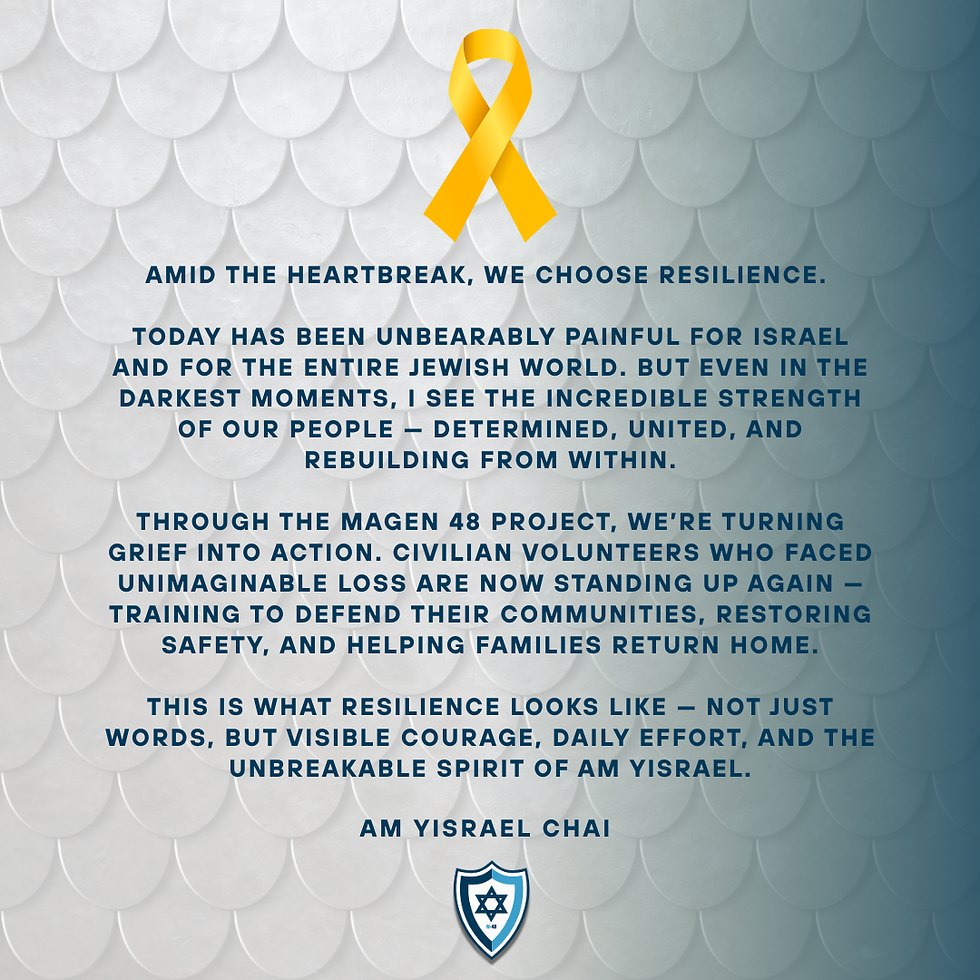
Magen 48 was born out of the ashes of war, but it will not disappear with it. It is building generational change. What starts in the Gaza Envelope will expand across Israel.
And make no mistake—October 7th can and will happen again.
Next time, towns will be ready. Not because of hope or luck, but because of the work we are doing now.
After 407 days of reservist service, this is the chapter I am proud to write myself into—the chapter of Israel’s future.
VI. Thank You
To the Magen 48 team for welcoming me into this vision: Ari, Ehud, Gilad, and our incredible advisory board—Mike Aron and Kurt Schwartz. Thank you for letting me be part of this mission.
And to you reading this—
Come make a difference with us. Support Magen 48. Help rebuild Israel’s frontline communities. Help us bring everyone home.


Comments